


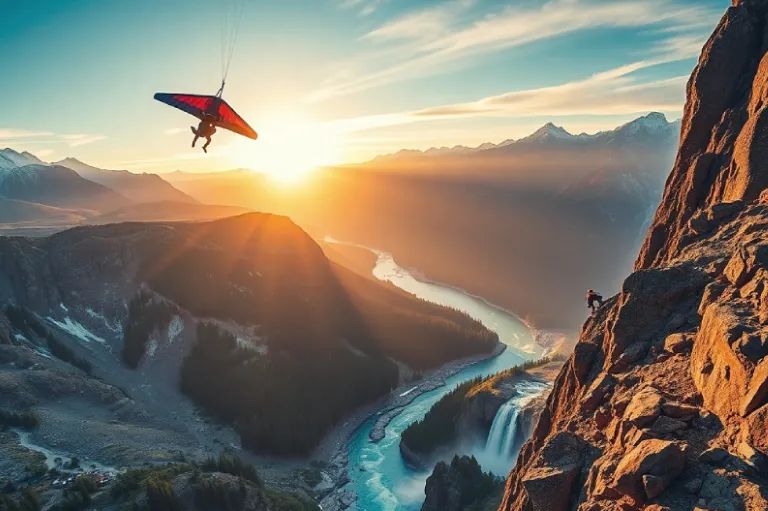
What Counts as a Thrill-Seeking Adventure Activity?
For this guide, thrill-seeking means activities that combine genuine physical challenge with adrenaline not just scenic hikes or beginner surf lessons. These are activities where the risk is real, the preparation matters, and the experience is one most people never attempt.
They’re divided below by the type of adrenaline they deliver: airborne, water, terrain-based, and extreme endurance.
Airborne Thrills: The Best Activities for Those Who Want to Leave the Ground
Skydiving: Where to Do It and What to Expect
Skydiving delivers a very specific kind of experience a freefall from 10,000-15,000 feet, a 60-second freefall at 120+ mph, then a parachute descent that’s surprisingly calm. First-timers do tandem jumps with an instructor. After proper certification (typically an AFF course taking 7-10 days), solo jumps become possible.
The best locations for skydiving include Queenstown (New Zealand) for mountain and lake views during descent, Interlaken (Switzerland) for the Alps backdrop, Fox Glacier (also New Zealand), and Monterey Bay (California) for coastal jumps. Dubai’s indoor skydiving at iFly is not the same thing but works as preparation.
Cost: Tandem jumps run $200-$350 depending on altitude and location. AFF certification courses run $1,500-$2,500.
Wingsuit Flying: The Most Extreme Airborne Sport
Wingsuit flying means wearing a suit that creates a wing surface between the arms and legs, dramatically reducing descent speed and allowing horizontal gliding. In proximity wingsuit flying the most extreme variant athletes fly within meters of cliff faces and ridgelines at 250+ km/h.
This is not for beginners. Standard wingsuit jumping requires at minimum 200 solo skydive jumps before training begins. Base wingsuit requires even more experience. The fatality rate is significant, and proximity flying has a higher risk profile than almost any other mainstream extreme sport.
That said, watching skilled wingsuit pilots fly through narrow passes in the Alps or Dolomites is genuinely extraordinary, and the sport continues to attract serious athletes who accept the risk profile and train accordingly.
Paragliding vs. Hang Gliding — What’s the Difference for Beginners?
Paragliding uses an inflatable wing launched on foot from a hill. Hang gliding uses a rigid frame. Both allow extended soaring flight using thermal currents. Paragliding is easier to learn and pack-and-carry. Hang gliding offers higher speeds and more technical performance.
Best paragliding locations: Pokhara (Nepal) over the Himalayas, Oludeniz (Turkey) over the Aegean, and Queenstown (New Zealand). Most locations offer tandem flights for beginners no experience required, just launch with an instructor.
Water-Based Thrills: Rapids, Waves, and the Deep
White-Water Rafting: Grade 5 vs. Grade 3 — Know What You’re Signing Up For
White-water rafting is graded 1-6, with Grade 6 considered unrunnable. Grade 3 is accessible to most adults with basic fitness and no experience. Grade 4 involves powerful waves and some risk of capsizing. Grade 5 is intense, physically demanding, and should only be attempted with experienced guides on specific rivers with proven safety records.
The best Grade 4-5 rafting destinations include: the Zambezi River below Victoria Falls (Zimbabwe/Zambia), the Futaleufú River in Chile (considered one of the world’s best technical rivers), the Kali Gandaki in Nepal, and the Ocoee River in Tennessee for North American options.
Rishikesh, India, on the Ganges river is the most popular budget option globally. It offers Grade 3-4 rapids, is very accessible, and has been running commercial rafting tours for decades.
Shark Cage Diving: What Actually Happens
Shark cage diving involves descending in a metal cage alongside a dive boat while great white sharks (or other species depending on location) are attracted to the boat using chum or decoys. The cage keeps divers safe. No diving certification is typically required for surface cage experiences you breathe through a regulator but stay near the surface.
Gansbaai, South Africa is the world’s most established great white shark cage diving destination. The Farallon Islands off San Francisco and Guadalupe Island in Mexico also offer this. The white shark population in some locations has shifted over the years, so check operator reports before booking sightings are not guaranteed.
Big Wave Surfing: Spectating vs. Doing
Watching the XXL waves at Nazaré in Portugal or Jaws (Peahi) in Maui is in itself a stunning experience that any traveler can access. These waves hit 20-30 meters during peak season and attract the world’s best big wave surfers.
Actually riding these waves requires years of competitive surfing background, specific tow-in equipment training, and a safety team. For most thrill-seekers, the realistic entry point is professional surf instruction in decent waves overhead-high surf at a beach with proper rip current safety knowledge is still a significant challenge for most adults.
Terrain-Based Thrills: Climbing, Jumping, and Running Where You Shouldn’t
Bungee Jumping: The Classic Adrenaline Benchmark
Bungee jumping is one of the most accessible extreme activities. You jump from a platform, bridge, or crane, a cord attached to your ankles or harness stretches to absorb your fall, and you bounce. The whole active experience is under 30 seconds.
The highest commercial bungee jump in the world is at the Macau Tower in China 233 meters. The Kawarau Bridge in Queenstown (43 meters) is the world’s first commercial bungee site and remains one of the most popular. The Bloukrans Bridge in South Africa at 216 meters is the highest bridge bungee.
Health restrictions apply consult operators about back problems, blood pressure issues, or recent surgeries. Pregnant women and those with certain cardiac conditions are not eligible.
Via Ferrata: Climbing Without Full Mountaineering Training
Via Ferrata (“iron road” in Italian) is a system of fixed iron rungs, cables, and ladders built into cliff faces in the Alps and Dolomites, allowing people with basic fitness to climb routes that would otherwise require advanced rock climbing skills.
The Dolomites in Italy and Switzerland’s Bernese Oberland have the most developed Via Ferrata networks. Some routes are extremely exposed you’re clipped to a cable while traversing a near-vertical face with nothing below but a 500-meter drop. No technical climbing background needed, but a harness, helmet, and via ferrata set are required.
Volcano Hiking: Active Craters Worth the Risk
Hiking to the edge of an active volcanic crater is a legitimately extreme experience that combines physical challenge with genuine geological drama. Mount Etna in Sicily is the most accessible active volcano in Europe and offers guided crater-edge hikes. Mount Yasur on Vanuatu’s Tanna Island allows visitors to stand at the rim and watch magma explosions at close range it’s one of the most accessible active volcanoes anywhere.
Pacaya Volcano in Guatemala can be hiked in a half-day from Antigua. The summit of Mount Bromo in Indonesia offers a more dramatic approach you arrive by 4×4 in darkness, trek across a lunar landscape, and reach the crater rim at sunrise.
BASE Jumping: Legally Accessible Locations
BASE (Buildings, Antennae, Spans, Earth) jumping involves parachuting from fixed structures rather than aircraft. The proximity to the ground means the parachute must open almost immediately, requiring specific equipment and training. It’s not legally accessible everywhere — many locations restrict it or require permits.
The Kjerag plateau in Norway and Lauterbrunnen Valley in Switzerland are the most established legal BASE jumping destinations with active communities. Moab, Utah has designated sites with organized jump days. This is a progression sport — skydiving experience is an absolute prerequisite.
Endurance and Multi-Day Challenges
Ultra-Trail Running: Racing Through Mountains
Ultra-trail running has grown from a niche sport to a mainstream adventure challenge with events on every continent. Races range from 50K to 170K+ kilometers through technical mountain terrain, usually with significant elevation gain and self-sufficiency requirements.
Iconic events include UTMB (Ultra-Trail du Mont-Blanc) in Chamonix, France the most prestigious 170K race in the world the Tor des Géants in the Aosta Valley (330K), the Dragon’s Back Race in Hong Kong, and the Hardrock 100 in Colorado. Entry is typically by lottery. Training requirements are substantial: most entrants have a multi-year running background.
Multi-Day Desert Races
The Marathon des Sables in Morocco a six-day, 250-kilometer race across the Sahara — is described by many participants as the hardest footrace on Earth. Competitors carry all their food for the week; organizers provide water and overnight tents. Temperatures regularly exceed 50°C.
The Atacama Crossing (Chile) and the Gobi March (Mongolia) are part of the same 4 Deserts series and offer comparably extreme experiences in different environments. These are achievable for well-prepared non-professional athletes, but preparation takes 12-18 months minimum.
How to Get Started With Adventure Sports Safely
- Start with tandem or guided experiences before pursuing certifications. Every sport has an accessible entry point.
- Research operators thoroughly. Check safety records, certification, and recent reviews. Cheap operators in extreme sports cut corners that matter.
- Get physically prepared before arrival. Bungee jumping has no fitness requirement, but volcano hiking, rafting, and climbing all benefit from baseline fitness.
- Take out appropriate adventure sports insurance. Standard travel insurance excludes most high-risk activities.
- Know your medical restrictions. Heart conditions, high blood pressure, back injuries, and recent surgeries disqualify you from certain activities.
- Tell someone where you’re going and when you expect to return when doing solo or independent activities.
Conclusion
Thrill-seeking in 2026 has more options, more access, and better safety standards than at any point in history. Most of the activities on this list bungee jumping, tandem skydiving, white-water rafting, via ferrata are accessible to adults with average fitness and no prior experience. The more extreme end wingsuit flying, BASE jumping, big wave surfing requires years of progression and a serious commitment to safety culture.
Start where your skill level honestly sits. The progression from first bungee jump to solo skydive to paragliding certification to via ferrata is available to almost anyone who wants it. The extreme end will still be there when you’re ready.
Frequently Asked Questions
Q: What is the most accessible extreme sport for beginners? Tandem skydiving and bungee jumping require no prior experience or training. White-water rafting at Grade 3 is also very accessible. All three can be done in a day with no background.
Q: What’s the most dangerous adventure sport? BASE jumping and proximity wingsuit flying have statistically high fatality rates relative to participants. Cave diving, free solo rock climbing, and big wave surfing also carry extreme risk profiles.
Q: Does adventure sports insurance cover all activities? No. Standard policies often exclude activities deemed “high risk.” World Nomads and specialist insurers like Battleface offer adventure sports add-ons. Always read the policy schedule before purchasing.
Q: Where is the best place in the world for adventure sports? Queenstown, New Zealand, is consistently ranked the adventure sports capital of the world, offering bungee, skydiving, jet boating, white-water rafting, paragliding, and skiing within a short radius. Interlaken, Switzerland, offers a comparable European alternative.
Q: How fit do you need to be for most adventure activities? Tandem skydiving, bungee jumping, and shark cage diving have minimal fitness requirements. Volcano hiking, white-water rafting, and via ferrata benefit from moderate fitness. Ultra-trail running and desert races require serious athletic preparation.
