


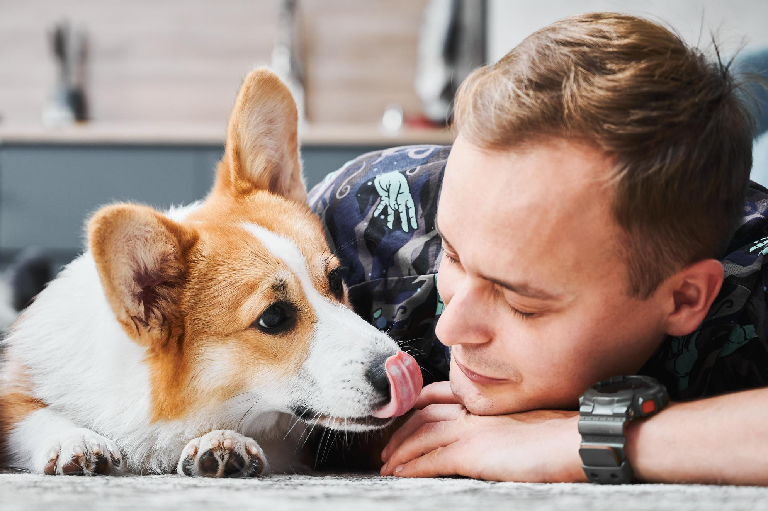
Most dog owners will tell you their dog just knows when something’s wrong. They curl up closer, rest their head on a knee, or stay quieter than usual. It feels intuitive — but is there actual science behind it?
Turns out, yes. Research over the past two decades has built a solid case that dogs are genuinely tuned into human emotional states. Not in a supernatural way, but in a very real, measurable way rooted in biology and co-evolution.
What Does the Research Actually Say?
Multiple studies have looked directly at how dogs process human emotional signals. The findings are consistent and fairly striking.
A 2015 study published in Current Biology by researchers at the University of Lincoln and University of Sao Paulo found that dogs could match emotional expressions with corresponding vocalizations. When shown a happy human face alongside an angry one while hearing either a happy or angry voice, dogs looked longer at the face that matched the voice. They were cross-referencing audio and visual emotional cues something previously only confirmed in humans and primates.
A 2016 study from Emory University used fMRI brain scans on dogs and found that the caudate nucleus a reward center in the brain activated more strongly in response to human scent than to any other scent, including food. Dogs are literally neurologically wired to respond to humans.
Dogs and the Human Gaze
One specific behavior stands out: eye contact. Dogs are the only non-human animal that consistently seeks out eye contact with humans as a social signal. Wolves even those raised by humans don’t do this. It’s a domestication-specific trait.
When a dog makes eye contact with a familiar human, both species release oxytocin the same bonding hormone involved in parent-child attachment. This mutual gaze loop is part of why the dog-human bond feels so strong, and it’s also part of how dogs pick up on emotional states.
Recognizing Happy vs. Angry Faces
A study from the University of Veterinary Medicine in Vienna tested whether dogs could distinguish between happy and angry human faces even when only shown half a face. Dogs trained to touch a screen to identify a happy face could apply that learning to new faces they hadn’t seen before. They also learned the task faster when the reward face was happy rather than angry, suggesting emotional valence matters to them.
Can Dogs Tell When Someone Is Stressed or Sad?
This is where it gets more nuanced. Dogs clearly detect emotional states but whether they understand what those states mean is a harder question.
Dogs are highly sensitive to stress signals. Research shows they can detect cortisol the stress hormone through smell. A 2022 study from Queen’s University Belfast found that trained dogs could identify samples from people who were stressed (after a mental arithmetic task) at a rate significantly above chance. The dogs weren’t reacting to sweat or general body odor they were picking up on the biochemical change stress produces.
Empathy or Emotional Contagion?
Scientists debate whether dogs experience true empathy or something called emotional contagion essentially catching a feeling from another being without fully understanding the cause. The distinction matters because true empathy involves perspective-taking, which is cognitively more complex.
A study published in Learning and Behavior found that dogs approached and comforted people who were crying more than people who were humming quietly, even when the crying person was a stranger. The dogs also offered physical contact (nuzzling, licking) in response to distress. Whether this counts as empathy or conditioned emotional response is still debated but the behavior itself is consistent and measurable.
How Do Dogs Use Tone of Voice to Read Emotions?
Dogs pay close attention to how something is said, not just what is said. Studies have shown that dogs’ brain responses to speech follow patterns similar to humans they process emotional tone in the right hemisphere and meaningful word content in the left hemisphere.
A 2016 study by Attila Andics and colleagues at Eotvos Lorand University in Budapest used fMRI to show that dogs activated reward-related brain areas when they heard both praising words AND praising tone together. Praising words with a neutral tone or neutral words with praising tone each triggered a weaker response. This suggests dogs integrate verbal content and emotional tone, similar to how humans do.
What This Means for How Owners Communicate
This research has practical implications. Talking to a dog in an upbeat tone while actually being upset can confuse them they pick up on the mismatch. Dogs are watching posture, hearing vocal patterns, and smelling biochemical signals simultaneously. They’re building a composite read of an emotional state.
Do All Dog Breeds Read Emotions Equally Well?
Breeds that were selected specifically to work closely with humans herding dogs, service dogs, assistance breeds like Labrador Retrievers and Golden Retrievers tend to score higher on social cognition tasks. But even breeds with less direct human-interaction history show significant emotional recognition ability.
Age matters too. Puppies show social referencing behavior (looking to a human’s face for cues about how to respond to a novel object) at a very young age. This suggests the capacity is present early and doesn’t require extensive training to emerge.
What About Dogs and Human Mental Health?
The dog-emotion connection has real clinical applications. Therapy dogs are used in hospitals, schools, and mental health settings because they reliably reduce cortisol levels and increase oxytocin in the people they interact with. Their ability to respond to emotional states without judgment or language makes them uniquely effective in therapeutic contexts.
Animal-assisted therapy programs have shown measurable results for PTSD, anxiety disorders, and depression. While dogs don’t understand the clinical details of these conditions, they respond to the behavioral and physiological signals these conditions produce and their response is often calming.
Conclusion: Dogs Know More Than Most People Realize
The evidence is solid. Dogs understand human emotions not the way another human would, but in a way that’s real, measurable, and evolved specifically through their long history alongside people. They read faces, voices, body language, and scent. They respond to distress. They seek out emotional connection.
The next time a dog seems to know something is wrong before anyone says a word, that’s not imagination. That’s thousands of years of co-evolution doing exactly what it was designed to do.
Frequently Asked Questions
Q1: Can dogs sense when their owner is sad?
Yes. Dogs detect emotional states through multiple channels — facial expressions, tone of voice, body posture, and biochemical signals like cortisol. Research shows they approach and comfort people who are distressed, even strangers, more consistently than people who are neutral.
Q2: Do dogs understand human facial expressions?
Yes. Studies show dogs can distinguish between happy and angry human faces, match facial expressions with corresponding emotional vocalizations, and apply what they’ve learned to new, unfamiliar faces.
Q3: Can dogs smell emotions?
Dogs can detect biochemical changes associated with emotional states. A 2022 study from Queen’s University Belfast confirmed that trained dogs can identify stress-related changes in human scent at a rate well above chance.
Q4: Do dogs feel empathy?
Dogs show behaviors consistent with empathy — approaching and comforting distressed individuals, responding to crying differently than other sounds, and offering physical contact in response to emotional distress. Whether this constitutes full cognitive empathy or emotional contagion is still debated among researchers.
Q5: Why do dogs stare into their owner’s eyes?
Eye contact with familiar humans triggers oxytocin release in both the dog and the human. This mutual gaze bonding is unique to dogs among non-human animals and is believed to have developed through domestication as a mechanism for social communication.
Q6: Are some dog breeds better at reading emotions than others?
Breeds selected for close human collaboration — such as Labrador Retrievers, Golden Retrievers, and herding breeds — tend to score higher on social cognition tasks. However, most dogs across breeds show significant emotional recognition ability.
